



Mathematics
At Dallas Road we aim for children to learn with:
- Competence and confidence in mathematical concepts
- A can-do attitude that all children can achieve in mathematics
- Fascination, children find awe and wonder in numbers
- A carefully planned, coherent curriculum which builds on previous learning and understanding
- An ability to communicate clearly using mathematical terminology
- Be fluent with number facts
- An ability to:
- develop secure fluency in number facts
- think mathematically:
- Reason
- Problem solve
- Make connections with real life examples
How do we teach maths at Dallas Road?
At Dallas Road we follow a ‘mastery’ approach for the teaching and learning of Maths.
We do this by:
- Giving all children sufficient time to grasp understanding
- A focus of depth of understanding not breadth
- We use the 5 Big Ideas from the NCETM (National Centre for Excellence in the Teaching of Mathematics)
The 5 Big Ideas
Our mastery approach is underpinned by the NCETM's Five Big Ideas, which support the development of deep, connected and lasting mathematical understanding.
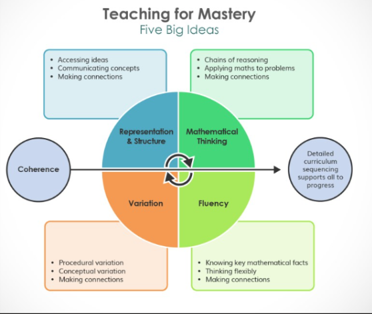
Coherence
- Teaching is designed to enable a coherent learning progression through the curriculum
- We follow the small steps as outlined by White Rose
- We only move onto the next step when most children have shown understanding
- We believe in depth of understanding
Representation and Structure
- Representations expose mathematical structure and support understanding rather than act as shortcuts.
- Visual representations reduce language barriers and assist all children
- Children have access to manipulatives in lessons
Mathematical Thinking
- Children are encouraged to think mathematically by making connections, identifying patterns, reasoning relationships, and justifying their ideas using precise mathematical language.
- Teachers promote deep understanding through purposeful questioning, discussion, and opportunities for children to explain, prove, and evaluate different strategies.
Variation
- Carefully designed variation enables children to notice mathematical structures and relationships by comparing examples and non-examples.
- Through procedural and conceptual variation, children develop a deeper understanding of mathematical concepts and learn to apply their knowledge flexibly in different contexts.
Fluency
- Children develop fluency through frequent practice, retrieval, and the efficient use of known facts, enabling them to recall and apply knowledge with accuracy and confidence.
- Fluency is developed alongside conceptual understanding, ensuring children can select appropriate strategies and apply them flexibly when solving problems and reasoning mathematically.
Vocabulary and oracy
Our community has a high proportion of children with EAL. As a result, ‘closing the vocabulary gap’ is important to us. We identify key vocabulary to be explicitly taught which will deepen the children’s understanding of maths and allow them to speak about maths.
- Mathematical vocabulary is visible, explicitly referenced and regularly revisited.
- Children use precise mathematical vocabulary when explaining and discussing their thinking.
- Sentence stems and structured talk support children in articulating mathematical ideas.
- Children explain, justify and prove their reasoning using complete mathematical sentences.
- Rich mathematical discussion is evident throughout lessons.
- Questioning and discussion are used to check understanding of mathematical vocabulary and concepts.
Teaching and learning
Mathematics is taught through a mastery approach that develops fluency, reasoning and problem-solving. Teaching and learning is characterised by:
- Opportunities to revisit and build upon prior learning.
- Regular practice to develop fluency and confidence with numbers.
- Whole-class teaching where most children learn the same mathematical concept, with adaptations focused on access, representation, language, and scaffolding.
- The use of concrete and pictorial representations to support conceptual understanding.
- Clear and explicit teaching of mathematical concepts and vocabulary.
- Opportunities for children to explain, justify, and discuss their mathematical thinking.
- Careful use of variation to deepen understanding and highlight mathematical structures.
- Prompt identification and addressing of misconceptions through responsive teaching.
- Opportunities to apply learning through reasoning and problem-solving activities.
Curriculum
For consistency and progression, the school uses the DfE approved White Rose Maths scheme.
Across Key Stage 1 and Key Stage 2, we use the structure of the White Rose curriculum to sequence our learning into small steps.
Our curriculum goes beyond the materials provided by White Rose Maths, using a range of high-quality resources, representations, manipulatives and questioning techniques to deepen understanding and meet the needs of all learners.
Inclusion
We believe that all children can be successful mathematicians. Through a mastery approach, all children are supported and challenged to achieve their potential.
- We have high expectations for all children and believe everyone can succeed in mathematics.
- Children learn together through whole-class teaching, with support and challenge provided where needed.
- Adaptations focus on access through scaffolding, representations, manipulatives, and mathematical talk rather than reducing expectations.
- Mathematical vocabulary and discussion are explicitly taught to ensure all children can participate fully in learning.
- Responsive teaching and timely intervention help children secure understanding and address misconceptions quickly.
Interventions
Teachers use the NCETMs Ready to Progress Criteria to track children who are Below Age-Related Expectations.
Targeted interventions are used to address misconceptions and support pupils in developing secure understanding.
Calculation Policies
Mental Calculations Policy Addition & SubtractionMental Calculations Policy Multiplication & Division